Best Treadmills for Home (2026): 7 Picks for Runners
Updated October 26, 2026 | By the Review Riches teamPrices and specifications were checked against manufacturer and retailer listings on October 26, 2026. Prices change often, especially around sales events, so confirm the live price before you buy.
Affiliate disclosure: Review Riches is reader-supported. When you buy through links on this page, we may earn an Amazon commission at no extra cost to you. That is how we keep the site free. It never changes which products we pick: every model below was chosen from manufacturer specifications, retailer listings and published expert roundups, and the flaws of each pick are stated in its review.
The Short Answer
If you run at home, buy a real running treadmill, not a walking pad with a bigger motor sticker. A runner needs three things a walking pad cannot give you: a belt at least 60 inches long, a continuous-duty motor of at least 3.0 CHP, and a top speed of 10 to 12 mph. Anything less and you will shorten your stride, overheat the motor, and stop using the machine within a year. For most runners, the NordicTrack Commercial 1750 is the right buy: a 22 by 60 inch belt, a 4.25 CHP motor, decline as well as incline, and iFit classes that change the speed and grade for you. If you do not want a subscription, buy the Sole F80 instead — the same size belt and a lifetime frame and motor warranty, with no monthly fee. If your budget is around $1,000, the Horizon 7.0 AT and the Sole F63 are the two honest choices, both with a 60-inch belt and a 3.0 CHP motor. The other three picks below each win for one specific situation: a flat-folding apartment machine, a first treadmill under $300, or a small-space machine with a touchscreen and guided classes. What a home treadmill will not do is replace outdoor running completely. It is a training tool for bad weather, dark mornings, and consistent mileage. The best machine for you is the one you will actually run on four times a week, in the space you actually have, at a price that does not make you wince every time you look at it. If you mainly walk while you work, read our guide to the
best walking pads in the USA instead — a walking pad is cheaper, quieter, and smaller, and it is the right tool for desk hours.
Quick Picks Table — All Seven at a Glance
| Model | Best for | Price | Speed | Belt | Capacity | Incline |
|---|
| NordicTrack Commercial 1750 | Best overall / iFit | $2,499 list; ~$1,899–$1,999 on Amazon | 0–12 mph | 22 x 60 | 400 lb | -3% to 12% |
| Horizon 7.0 AT | Best budget for runners | $999 sale (list $2,099) | 0.5–12 mph | 20 x 60 | 325 lb | 0–15% |
| Sole F63 | Best value, no subscription | $1,099 sale (list $1,299.99) | 0.5–12 mph | 20 x 60 | 325 lb | 0–15% |
| Sole F80 | Heavy-duty / high mileage | $1,799.99 sale (list $1,899.99) | 0.5–12 mph | 22 x 60 | 350 lb | 0–15% |
| Echelon Stride | Compact apartment | ~$1,179 on Amazon (list $1,599) | 0.5–12 mph | 20 x 55 | 300 lb | 0–10% |
| DeerRun A1 Pro Move+ | Cheapest folding | $269 (list $409) | 0.6–10 mph | ~44 x 16.5 (unverified, third-party) | 350 lb | 6% manual |
| ProForm Carbon T7 | Budget iFit / small space | $999 sale (list $1,403) | 0–10 mph | 20 x 55 | 300 lb | 0–10% |
Prices checked October 26, 2026 on the manufacturer’s US store or a major US retailer. Treadmill prices move a lot around sales events, so treat every price here as a checked price on that date, not a promise.DeerRun belt size is from third-party listings, not from DeerRun’s current product page — see the DeerRun review below.How We Chose
We started from the models US runners actually buy and that expert testers keep recommending in 2026, then filtered them using manufacturer specification sheets rather than marketing pages. A model had to publish its belt size, weight capacity, motor type, folded dimensions and warranty before it could be considered. Models that hid those numbers were dropped, however good their photos looked. Belt size first: we treated 60 inches long and 20 inches wide as the floor for a running treadmill. Shorter belts stayed in the list only when they won on price or size, and the trade-off is stated in the review — the Echelon Stride and the DeerRun are the two exceptions, and both are flagged as such. Continuous horsepower, not peak horsepower: for regular running, look for a motor rated at least 3.0 CHP. Peak HP numbers are marketing figures measured for a few seconds. Capacity with headroom: buy a machine rated at least 20 lb above your body weight. Storage you will actually use: folded dimensions and unit weight matter more than the unfolded footprint. Subscription cost counts: a $39-a-month iFit membership adds $468 a year. That is part of the price of a NordicTrack or a ProForm, and it is stated in the review, not hidden. Warranty is the hidden price difference: the gap between a 1-year warranty and a lifetime frame and motor warranty is the single most under-reported difference in this category. One honest limit: this is a research-based guide built from manufacturer data, retailer listings and published expert testing, including the roundups from Garage Gym Reviews, Running Gear Lab, and Run Reviews. It is not a hands-on lab test, and we do not claim it is one. Where sources disagreed — on the NordicTrack 1750’s motor and warranty, on the Sole F80’s capacity, and on the DeerRun’s motor — we say so in the review instead of picking the friendliest number.
Check price: NordicTrack.com
Price: $2,499 at NordicTrack on October 26, 2026. Amazon price trackers showed $1,899 on September 20, 2026 and $1,999 in late 2025 for the current model (NTL17125, 16-inch screen), so check Amazon before paying full price — the same model name has been sold in several model years, with 10-inch, 14-inch and 16-inch screens.
NordicTrack Commercial 1750: a 22 by 60 inch belt, decline training, and a pivoting touchscreen.The Commercial 1750 is the treadmill we would hand to a runner who asked for one recommendation and no homework. It is the best-selling home running treadmill in the US for a reason: a 22 by 60 inch belt that fits tall runners, a 4.25 CHP motor in the current model, 0 to 12 mph, and the one feature almost no rival at this price offers — decline. The deck runs from -3% downhill to 12% uphill, so hill training and downhill running both work, and iFit trainers change the speed and grade for you during classes. The 16-inch pivoting touchscreen streams more than 10,000 iFit workouts, and you can turn the screen to follow off-treadmill strength and yoga classes beside the belt. Runner’s Flex cushioning can be switched on to soften landings or off to feel like road running. Two honest warnings. First, the smartest features sit behind iFit. You can run manually without a membership, but automatic trainer control, guided classes and streamed workouts need iFit Pro, about $39 a month after the included trial. Over three years that adds more than $1,400 to the real cost. Second, NordicTrack has sold the 1750 in several versions. Older listings show a 3.75 CHP motor, a 10-inch screen and a 300 lb capacity; the current model shows 4.25 CHP, a 16-inch screen and a 400 lb capacity. Check the model number (NTL17125 for the current 16-inch version) and the screen size on the listing you actually buy from, because the price and the specs move together. At 311 lb with SpaceSaver folding and EasyLift assist, it folds — but it is heavy, and it needs a permanent spot.
Pros:- Best all-round running spec in this guide
- Decline as well as incline
- Large pivoting touchscreen
- iFit auto-adjusts speed and grade
- Folds with EasyLift assist
- 400 lb capacity in the current model
Cons:- Full iFit experience needs a $39-a-month membership after the trial
- Model-year specs vary, so the listing must be checked
- Heavy at about 311 lb
- Warranty is shorter than Sole’s lifetime cover
Skip it if: you do not want a subscription, or you want the longest warranty — buy the Sole F80 instead.
| Price | $2,499 list; ~$1,899–$1,999 on Amazon |
|---|
| Speed | 0–12 mph |
|---|
| Motor | 4.25 CHP (current model; older models 3.5–3.75 CHP) |
|---|
| Belt | 22 x 60 in |
|---|
| Capacity | 400 lb (current model; older models 300 lb) |
|---|
| Unit weight | ~311 lb |
|---|
| Incline | -3% to 12% |
|---|
| Size | 77.3 x 37 x 59.5 in |
|---|
| Controls | 16 in pivoting touchscreen, iFit |
|---|
| Warranty | 10-year frame, 2-year parts, 1-year labor (Garage Gym Reviews 2026; older listings differ — check your model year) |
|---|
Pick 2 — Horizon 7.0 AT — Best Budget Treadmill for Runners
View on Amazon Horizon Fitness
Price: $999 on sale at a Horizon dealer on October 26, 2026 (list price $2,099). It is regularly sold for $999 to $1,099, so do not pay list price.
Horizon 7.0 AT: a 60-inch belt and a 3.0 CHP motor for about $1,000 on sale.The 7.0 AT is the cheapest treadmill in this guide that a serious runner should actually buy. It has the two numbers that matter — a 20 by 60 inch belt and a 3.0 CHP RapidSync motor — for about $1,000 on sale, and it does it without a subscription. The motor responds fast to speed changes, which matters for intervals, and the QuickDial handlebar controls let you change speed and incline without hunting for buttons mid-sprint. Bluetooth connects to Peloton, Zwift, Strava and Kinomap, and to Apple Watch and Samsung Galaxy Watch, so you bring your own screen and your own app instead of paying for a built-in one. It folds with one-step hydraulic folding to 44 by 35 by 68 inches, and the lifetime frame and motor warranty is the same class of cover Sole offers. The trade-offs are the screen and the weight. There is no touchscreen — a 7.25-inch LCD and four LED windows, plus a tablet holder. If you want guided classes on a big built-in screen, this is not your machine. At 277 lb it is also heavy for a “budget” treadmill, and the 3-year parts and 1-year labor warranty is shorter than the Sole F80’s. But for a runner who wants a 60-inch belt, a real motor, and no monthly fee, the 7.0 AT is the value pick in this guide, and expert testers at Garage Gym Reviews and Running Gear Lab keep putting it at the top of the under-$1,000 list for exactly that reason.
Pros:- Real running spec for about $1,000 on sale
- Fast motor response for intervals
- QuickDial controls
- Works with Zwift, Peloton and Strava with no subscription
- Lifetime frame and motor warranty
Cons:- No touchscreen — bring your own tablet
- Heavy at 277 lb
- 3-year parts warranty is shorter than Sole’s
- Basic built-in programs
Skip it if: you want a big built-in screen and guided classes — buy the NordicTrack 1750 or the ProForm Carbon T7 instead.
| Price | $999 sale (list $2,099) |
|---|
| Speed | 0.5–12 mph |
|---|
| Motor | 3.0 CHP RapidSync |
|---|
| Belt | 20 x 60 in |
|---|
| Capacity | 325 lb |
|---|
| Unit weight | 277 lb |
|---|
| Incline | 0–15% |
|---|
| Size | 76 x 35 x 67 in; folded 44 x 35 x 68 in |
|---|
| Controls | 7.25 in LCD, Bluetooth, QuickDial controls |
|---|
| Warranty | Lifetime frame and motor; 3 years parts; 1 year labor |
|---|
Check price: Sole Fitness
Price: $1,099 on sale on October 26, 2026 (list price $1,299.99). Sole sells direct from its own store, with free curbside shipping.
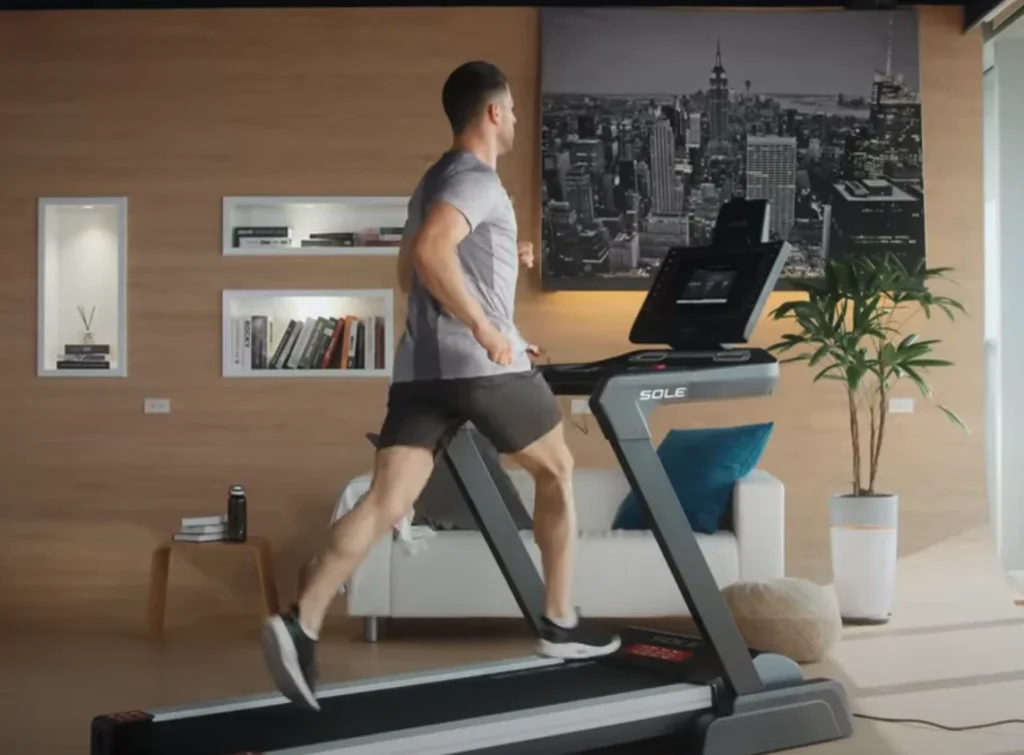
Sole F63: the entry-level Sole, with the same belt and motor as machines costing hundreds more.The F63 is Sole’s entry-level treadmill, and it is the best value in this guide for a runner who wants a tank and does not care about a touchscreen. It has the same running fundamentals as the Horizon 7.0 AT — a 20 by 60 inch belt, a 3.0 CHP motor, 0.5 to 12 mph, and 0 to 15% incline — with Sole’s CushionFlex Whisper Deck, which testers describe as firm rather than soft, and a lifetime frame and motor warranty. The 6.5-inch backlit LCD is basic, but the Sole+ app is free with no subscription, and Bluetooth connects to Zwift. It folds with a kick-release hydraulic assist to 50 by 35 by 72 inches, and at 224 lb it is the lightest full-size running treadmill in this guide. The honest limit is the same as the Horizon’s: no touchscreen, no guided classes built in, and a 325 lb capacity that is lower than the F80’s. Garage Gym Reviews’ tester also noted a slight shakiness at top speed on a high incline, though not enough to feel unsafe. If you are primarily walking, jogging, or doing the occasional run, the F63 is hard to beat for the money. If you are training for a marathon, step up to the F80 — the wider belt and stronger motor are worth it at that mileage.
Pros:- Best build quality per dollar in this guide
- Lifetime frame and motor warranty
- Free Sole+ app, no subscription
- Lightest full-size runner here at 224 lb
- Folds
Cons:- No touchscreen
- 325 lb capacity is lower than the F80
- Slight shake at top speed and high incline in expert testing
- Basic 6.5-inch display
Skip it if: you run high weekly mileage or you are over about 300 lb — buy the Sole F80 instead.
| Price | $1,099 sale (list $1,299.99) |
|---|
| Speed | 0.5–12 mph |
|---|
| Motor | 3.0 CHP |
|---|
| Belt | 20 x 60 in |
|---|
| Capacity | 325 lb |
|---|
| Unit weight | 224 lb |
|---|
| Incline | 0–15% |
|---|
| Size | 77 x 35 x 67 in; folded 50 x 35 x 72 in |
|---|
| Controls | 6.5 in backlit LCD, Sole+ app, Bluetooth |
|---|
| Warranty | Lifetime frame and motor; 2 years deck, parts and wear items; 1 year labor |
|---|
Check price: Sole Fitness
Price: $1,799.99 on sale on October 26, 2026 (list price $1,899.99). Sales to around $1,500 have been reported, so check before buying.
Sole F80: a 22 by 60 inch belt, a 3.5 CHP motor, and a warranty no rival matches.The F80 is the treadmill for runners who actually run — four or more times a week, 20-plus miles, year after year. It was originally designed as a folding treadmill for hotels, which is why it is built like a commercial machine: a 22 by 60 inch belt, a 3.5 CHP motor, 2.5-inch rollers, a 10.1-inch touchscreen, and a CushionFlex Whisper Deck that Sole says cuts joint impact by 40% compared with road running. The touchscreen runs Netflix, YouTube and other streaming apps, and the Sole+ app is free. There is no required subscription, which is the F80’s quiet advantage over the NordicTrack 1750: over three years, the F80 costs $1,799.99, while the 1750 costs $2,499 plus about $1,400 in iFit. The warranty is the best in this guide: lifetime on frame, deck and motor, 5 years on parts and electronics, and 2 years on labor, according to Garage Gym Reviews’ 2026 spec table. (Some retailer listings show shorter parts cover for older model years — check the listing you buy from.) The trade-offs are size and weight. At 274 to 278 lb and 82 inches long, it needs a dedicated spot, and it has no decline. Capacity is listed as 350 lb by Sole; some retailers list 375 lb for what appears to be the same machine — we use Sole’s own 350 lb figure here, and the difference does not change the recommendation.
Pros:- Strongest warranty in this guide
- 3.5 CHP motor and 22-inch belt for high mileage
- No required subscription
- 10.1-inch touchscreen with streaming
- Folds
Cons:- Heavy and large — needs a dedicated space
- No decline
- Costs $700 more than the F63 for a wider belt and a stronger motor
- Screen is smaller than the NordicTrack’s
Skip it if: you run less than three times a week, or your budget is under $1,200 — buy the Sole F63 or the Horizon 7.0 AT instead.
| Price | $1,799.99 sale (list $1,899.99) |
|---|
| Speed | 0.5–12 mph |
|---|
| Motor | 3.5 HP |
|---|
| Belt | 22 x 60 in |
|---|
| Capacity | 350 lb (Sole; some retailers list 375 lb) |
|---|
| Unit weight | 274–278 lb |
|---|
| Incline | 0–15% |
|---|
| Size | 82 x 37 x 66 in |
|---|
| Controls | 10.1 in touchscreen, Sole+ app, Bluetooth |
|---|
| Warranty | Lifetime frame, deck and motor; 5 years parts and electronics; 2 years labor |
|---|
Pick 5 — Echelon Stride — Best Compact Treadmill for Apartments
View on Amazon Echelon Fit
Price: $1,178.78 on Amazon US on October 13, 2026, sold and shipped by Amazon.com (list price $1,599). Echelon’s own store now sells the newer Stride-6 and Stride-6S instead of this original Stride, so Amazon is the place to find it new.
Echelon Stride: auto-folds flat to 10.25 inches thick and slides under a bed.The original Echelon Stride is the most apartment-friendly real treadmill in this guide. It auto-folds — push a lever and the console and handrails fold down over the deck — until the whole machine is 10.25 inches thick, flat enough to slide under a bed or stand against a wall. At 156 lb it is also the lightest full treadmill here, with transport wheels and a 4.5-inch step-up height, so one person can move it. It arrives 95% assembled, has 8 preset programs, a Bluetooth LED console, a tablet holder, USB charging, and the Echelon Fit app for live and on-demand classes. Now the honest part, because this pick has the weakest running spec in the guide. The motor is 1.75 continuous horsepower, not the 3.0 HP some retailers list — that higher figure appears to be a retailer error, and the 1.75 CHP figure comes from Echelon’s own spec sheet via Live Science. The belt is 55 by 20 inches, five inches shorter than the 60-inch floor we recommend for runners. That is fine for walking, jogging, and short runs, and for a smaller runner it is workable. It is not the right machine for a tall runner, a marathon block, or daily sprint intervals — the motor will be working hard, and the short belt will shorten your stride. The 1-year warranty is also the shortest in this guide. Buy the Stride because space is your real problem, not because it is the best running machine. If space is not the problem, the Horizon 7.0 AT gives you a longer belt and a stronger motor for less money.
Pros:- Auto-folds flat to 10.25 inches
- Lightest full treadmill here at 156 lb
- Arrives almost fully assembled
- 30-day Echelon membership trial included
- Good for apartments and small rooms
Cons:- Small 1.75 CHP motor — not for heavy daily running
- Short 55-inch belt
- 1-year warranty
- No touchscreen — bring your own tablet
Skip it if: you are over 6 ft, you run high mileage, or you have room for a full-size machine — buy the Horizon 7.0 AT instead.
| Price | ~$1,179 on Amazon (list $1,599) |
|---|
| Speed | 0.5–12 mph |
|---|
| Motor | 1.75 CHP (some retailers list 3.0 HP — that appears to be an error) |
|---|
| Belt | 20 x 55 in |
|---|
| Capacity | 300 lb |
|---|
| Unit weight | 156 lb |
|---|
| Incline | 12 levels, up to 10% |
|---|
| Size | 69.3 x 31 x 49.2 in; folded 69.3 x 31 x 10.25 in |
|---|
| Controls | LED console, Bluetooth, Echelon Fit app |
|---|
| Warranty | 1 year limited |
|---|
Pick 6 — DeerRun A1 Pro Move+ — Best Cheap Folding Treadmill
View on Amazon $269 at DeerRun.com on October 26, 2026 (list price $409). The A1 Pro AI version with a health watch is $289. Note: DeerRun’s page lists this model as a pre-order — check the pre-order date before buying.
DeerRun A1 Pro Move+: a first treadmill for $269, with a handrail and a 6% incline.The DeerRun A1 Pro Move+ is the cheapest real treadmill in this guide, and the only pick under $300. For $269 you get a machine that runs to 10 mph, has a 6% manual incline, a fold-flat handrail, a remote control, Bluetooth and the PitPat app, and a 350 lb capacity on an alloy steel frame. It folds, rolls on transport wheels, weighs 79.59 lb, and measures 53.35 by 24.06 by 44.57 inches — small enough for a studio apartment, a dorm room, or a bedroom corner. It is the right first treadmill for someone who is not sure they will run every day and does not want to spend $1,000 to find out. Be clear-eyed about what $269 buys. DeerRun’s current product page does not publish the motor horsepower or the belt size. Older A1 Pro listings say 3.0 HP, and a third-party review of the Move+ says 3.5 HP with a 44 by 16.5 inch belt — those two figures conflict, and neither is on the current manufacturer page, so we do not present either as verified. Treat the motor as unrated and the belt as short: this is a compact deck for walking, jogging, and light running, not a 60-inch running belt. The 6% incline is manual — set it before your workout, not mid-run. The warranty is 1 year, and the model is listed as a pre-order on DeerRun’s site. The old version of this article claimed a 3.5 HP motor and a 350 lb capacity for a DeerRun foldable without showing the source; the 350 lb capacity is on the current page, the motor figure is not, and we have not repeated it as fact.
Pros:- Cheapest real treadmill here by a wide margin
- Runs to 10 mph
- 350 lb capacity
- Manual incline adds intensity
- Folds and rolls away
- PitPat app and remote included
Cons:- Motor HP and belt size are not published on the current manufacturer page
- Short belt suits walking and light running, not long runs
- Manual incline only
- 1-year warranty
- Listed as a pre-order
Skip it if: you run regularly, you are tall, or you want a 60-inch belt — buy the Horizon 7.0 AT instead.
| Price | $269 (list $409) |
|---|
| Speed | 0.6–10 mph |
|---|
| Motor | Not published on DeerRun’s current page (older listings say 3.0 HP; one third-party review says 3.5 HP — not verified) |
|---|
| Belt | Not published on DeerRun’s current page (~44 x 16.5 in in third-party listings — not verified) |
|---|
| Capacity | 350 lb |
|---|
| Unit weight | 79.59 lb |
|---|
| Incline | 6% manual |
|---|
| Size | 53.35 x 24.06 x 44.57 in |
|---|
| Controls | Remote, Bluetooth, PitPat app |
|---|
| Warranty | 1 year |
|---|
Pick 7 — ProForm Carbon T7 — Best Budget iFit Treadmill for Small Spaces
View on Amazon ProForm
Price: $999 on sale on October 26, 2026 (list price $1,403). A 30-day iFit Family membership is included; after that iFit renews at about $39 a month.
ProForm Carbon T7: a 7-inch touchscreen and iFit classes in a folding frame for under $1,000 on sale.The Carbon T7 is the cheapest way to get a real touchscreen and trainer-led classes on a folding treadmill. For $999 on sale you get a 7-inch HD touchscreen, a 2.6 CHP motor, a 20 by 55 inch belt with ProShox cushioning, 0 to 10 mph, and 0 to 10% power incline, in a SpaceSaver folding frame with gas-shock assist and transport wheels. iFit trainers auto-adjust the speed and incline during classes, and the machine is small enough — 73.5 by 35.2 by 57.5 inches, 223 lb — for a spare bedroom or a living-room corner. It is the right pick for a walker or light jogger who wants guided classes and does not want to spend NordicTrack money. The limits are the same ones every expert tester flags. The 55-inch belt is short for a tall runner’s full stride, the 2.6 CHP motor tires under heavy daily sprinting, and the 7-inch screen feels cramped next to the NordicTrack’s 16-inch panel. There are no built-in preset programs — without iFit, you run in manual mode. Garage Gym Reviews’ tester also found the machine shaky on carpet, because it has no floor stabilizers, so put it on a hard floor with a mat. The warranty is 10 years on the frame and 1 year on parts and labor, though some listings show 2 years on parts — check your listing. If you run every day, buy the Horizon 7.0 AT instead; if you walk and jog with classes, the T7 is the better buy.
Pros:- Cheapest touchscreen + iFit package here
- Folds with gas-shock assist
- Cushioned deck is kind on knees
- 300 lb capacity
- Good for walkers and light joggers in small rooms
Cons:- Short 55-inch belt
- 2.6 CHP motor is not for heavy daily running
- Small 7-inch screen
- No built-in programs without iFit
- Shaky on carpet
Skip it if: you run daily or you are tall — buy the Horizon 7.0 AT or the Sole F63 instead.
| Price | $999 sale (list $1,403) |
|---|
| Speed | 0–10 mph |
|---|
| Motor | 2.6 CHP |
|---|
| Belt | 20 x 55 in |
|---|
| Capacity | 300 lb |
|---|
| Unit weight | 223 lb |
|---|
| Incline | 0–10% |
|---|
| Size | 73.5 x 35.2 x 57.5 in |
|---|
| Controls | 7 in HD touchscreen, iFit (30-day trial included) |
|---|
| Warranty | 10-year frame; 1 year parts and labor (some listings show 2 years parts) |
|---|
What We Fixed From the Old Version
The old article on this page promised “real pros and cons” and then gave none — no pros and cons, no prices, no spec table, and no FAQ. Its first pick was a Peloton laptop tray, not a treadmill, and it mixed walking pads, under-desk treadmills, and running treadmills as if they were the same machine. They are not. A walking pad tops out at 4 mph with a 2.0 to 2.5 HP motor and a 15-inch belt; a running treadmill needs a 3.0 CHP motor, a 60-inch belt, and 10 to 12 mph. This rewrite separates the two: if you mainly walk while you work, use our walking pads guide; this guide is for running. The LifeSpan TR1200-DT3 from the old article is a good under-desk walking treadmill, but it is not a runner’s treadmill, so it is not a pick here. The DeerRun, NordicTrack Commercial Series, and Echelon Stride names from the old article are kept — but with real prices, real specs, and real pros and cons this time.
Buying Guide: What Actually Matters in a Home Treadmill
Belt Size Decides Whether You Will Enjoy It
Measure your stride, not the marketing photos. As a working rule, look for a belt at least 60 inches long and 20 inches wide if you run, and longer if you are over 6 ft. Width matters as much as length: a narrow belt forces you to watch your feet, which is exhausting at 8 mph. In this guide, the NordicTrack 1750, Sole F80, Horizon 7.0 AT and Sole F63 all have 60-inch belts; the Echelon Stride and ProForm Carbon T7 have 55-inch belts, and the DeerRun is shorter still. Short is not automatically bad — it is the price of the Echelon’s flat fold and the DeerRun’s $269 price — but buy it knowingly.
Take Motor Ratings With a Pinch of Salt
Horsepower figures in this category are measured differently by every brand, which is why a $269 machine and a $2,499 machine can both claim numbers in the same range. Treat HP as a rough guide only, and look for the CHP (continuous horsepower) figure. What predicts a good experience is a 3.0 CHP motor or better, a capacity rating comfortably above your weight, and a belt that does not hesitate when your heel lands. If a listing leads with a huge HP number but hides its belt size and capacity, walk away. The DeerRun in this guide is the test case: its current page does not publish a motor figure at all, and we say so rather than repeating an old number.
Incline and Decline: Nice, Not Essential, and Two Different Kinds
Incline raises the effort of a run without raising the speed, which is ideal for training and for burning more calories in less time. Power incline, on every pick except the DeerRun, changes at the press of a button while you run. Manual incline, on the DeerRun, means stopping and setting it before your workout. Decline, on the NordicTrack 1750 only, lets you train downhill running — useful for race preparation, and almost never found at this price. If you mostly run flat at a steady pace, a flat treadmill is fine and cheaper.
Cushioning and Knees
Every pick here has some cushioning, but the systems differ. Sole’s CushionFlex Whisper Deck and NordicTrack’s Runner’s Flex cushioning are the most praised in expert testing; the Echelon Stride’s cushioning was the weakest in Garage Gym Reviews’ testing. If you have knee problems, cushioning matters more than the screen. Run in proper running shoes, not bare feet, and do not use a treadmill on a thick carpet — the deck needs a firm, level base, and the ProForm Carbon T7 in particular was shaky on carpet in testing.
You Need Space, Power, and a Mat
A full-size running treadmill is 76 to 82 inches long and 220 to 310 lb. Measure your room before you order: you need the machine’s footprint plus at least 2 feet of clearance on each side and 3 feet behind it. Most home treadmills need a standard 120V outlet on a dedicated circuit — do not use an extension lead, and do not plug it into a GFCI outlet if the manual says not to. A treadmill mat underneath protects hard floors, cuts vibration through the floor, and makes sliding the machine easier. If you live in an apartment, a mat is not an accessory, it is part of the purchase, and running in the morning is noticeably kinder to neighbours than running late at night.
Subscription Cost Is Part of the Price
NordicTrack and ProForm sell you a machine and then rent you the classes. iFit Pro is about $39 a month, or about $468 a year — over three years, more than the price of the Horizon 7.0 AT. Sole, Horizon and Echelon do not require a subscription to use the machine, though Echelon’s classes need one if you want them. Before you buy, add three years of subscription to the sticker price and compare that total, not the headline price.
Warranty Is the Hidden Price Difference
The gap between a 1-year warranty and a lifetime frame and motor warranty is the single most under-reported difference in this category. Belts wear, motors fail, and consoles die. Before buying, check what the warranty covers (motor, frame, deck, parts, labor), whether you pay return shipping on a 220 to 310 lb machine, and whether the brand sells replacement belts and parts in the US. Sole’s lifetime frame, deck and motor cover on the F80 is the best in this guide; the Echelon Stride and DeerRun 1-year cover is the shortest, and that difference is part of why they cost less.Between runs, sitting well matters too — see our guide to the
best office chairs if you spend long hours at a desk between runs.
Setup, Floor Fit and Keeping Your Treadmill Quiet
- Measure first. Check the room, the doorway the box has to fit through, the ceiling height when the deck is folded up, and the outlet. Then compare those numbers with the assembled and folded dimensions in the spec tables above.
- Put a mat down first. Place a treadmill mat on the floor before the machine arrives. It protects hard floors, reduces noise and vibration, and makes moving the machine easier.
- Assemble with two people. A 220 to 310 lb treadmill is not a one-person job. The Echelon Stride arrives 95% assembled; the NordicTrack, Sole and Horizon machines need assembly, and a paid assembly service is worth it if you live alone.
- Center the belt before your first run. Plug in, run the machine empty at low speed for a minute, and watch whether the belt drifts to one side. Adjust it using the rear bolts and the tool in the box, following your manual, before you stand on it.
- Start slower than you think. Begin with a walk, then a jog, then a run. Most runners settle at 5 to 7 mph for easy runs and save 8 mph and above for tempo and intervals.
Looking after it. Maintenance is simple but not optional. Keep dust and pet hair out from under the belt area, wipe the deck down weekly if you run daily, check belt centering monthly, and add silicone lubricant under the belt on the schedule in your manual. A dry belt is the most common cause of a treadmill getting louder and hotter over time. Keep the safety key clipped to your clothing when you run — if you fall, the belt stops. Finally, unplug the machine if young children or pets can reach the controls; a treadmill that starts unexpectedly is a genuine hazard.
Frequently Asked Questions
What is the best treadmill for home use in 2026?
For most runners, the NordicTrack Commercial 1750 — a 22 by 60 inch belt, a 4.25 CHP motor, decline training, and iFit classes. If you do not want a subscription, the Sole F80 is the best alternative, with the same belt size and a lifetime warranty. If your budget is around $1,000, the Horizon 7.0 AT and the Sole F63 are the honest choices. There is no single best treadmill for everyone; the best one is the one that fits your stride, your space, and your budget.
How much should I spend on a home treadmill?
Budget $1,000 to $2,000 for a treadmill you will actually run on. Under $500, you get a compact machine with a short belt and a small motor — fine for walking and light jogging, not for daily running. Between $1,000 and $1,300, the Horizon 7.0 AT and Sole F63 give you a real 60-inch belt and a 3.0 CHP motor. Between $1,800 and $2,500, the Sole F80 and NordicTrack 1750 give you a wider belt, a stronger motor, a bigger screen, and a better warranty. Add the subscription cost to the price before you compare: iFit at $39 a month adds $468 a year.
What size treadmill belt do I need for running?
At least 60 inches long and 20 inches wide for most adult runners, and longer if you are over 6 ft. A 55-inch belt, like the Echelon Stride and ProForm Carbon T7, works for walking, jogging, and shorter runners, but it will shorten a tall runner’s stride. A belt under 50 inches, like the DeerRun, is a walking and light-jogging belt, not a running belt.
What motor power do I need for running?
At least 3.0 CHP (continuous horsepower) for regular running. Walkers and light joggers are fine with 2.0 to 2.5 HP. Heavier runners, and anyone running daily, should look for 3.5 CHP or more, like the Sole F80. Ignore peak HP numbers — the continuous rating is what reflects sustained power. If a listing does not publish a CHP figure, treat that as a warning sign.
Do I need a subscription to use a treadmill?
No — every treadmill in this guide works in manual mode without a subscription. But the guided classes, automatic speed and incline changes, and streamed workouts on NordicTrack and ProForm need iFit, about $39 a month after the trial. Sole, Horizon and Echelon machines work fully with free apps and Bluetooth, and you can use Zwift, Peloton or Strava on your own tablet instead.
Are folding treadmills good for running?
Yes, if the folding machine has a real running spec. The NordicTrack 1750, Sole F80, Sole F63 and Horizon 7.0 AT all fold and all have 60-inch belts and 3.0 CHP or better motors. Folding does not mean flimsy — it means the deck lifts up with a hydraulic assist. What folding does cost you is weight and a permanent spot: a folding treadmill still weighs 220 to 310 lb, so it is not a machine you move every day.
How much space does a home treadmill take up?
Unfolded, the machines here run from about 53 inches long (DeerRun) to 82 inches long (Sole F80), and 24 to 39 inches wide. Folded, most stand upright and need about 44 by 35 inches of floor space, plus clearance behind them. The Echelon Stride is the exception: it folds flat to 10.25 inches thick and slides under a bed. Measure your room, your doorway, and your ceiling height before you order.
How do I maintain a home treadmill?
Four habits cover almost everything: keep the area under and around the belt free of dust and hair, check monthly that the belt is centered and not fraying at the edges, add the silicone lubricant supplied in the box on the schedule in your manual, and keep the power cord out of the running path. If the belt starts to slip, squeak or smell hot, stop using it and check the manual’s troubleshooting steps before running again. A dry belt is the most common cause of a treadmill getting louder and hotter over time.
The Verdict: Which Treadmill Should You Buy?
Buy the NordicTrack Commercial 1750 if you want the best all-round running machine and you are happy paying for iFit classes. Buy the Sole F80 if you run high mileage and want the best warranty with no subscription. Buy the Horizon 7.0 AT if your budget is around $1,000 and you want a real 60-inch belt without a monthly fee. Buy the Sole F63 if you want the best build per dollar and you do not care about a touchscreen. Buy the Echelon Stride only if space is your real problem and you mainly walk and jog. Buy the DeerRun A1 Pro Move+ only if your budget is under $300 and you are buying your first treadmill. Buy the ProForm Carbon T7 only if you want a touchscreen and iFit classes in a small space and you walk or jog lightly.Whichever you choose, spend the remaining money in the right order: a mat first, then good running shoes. Those two things decide whether a treadmill becomes a daily habit or a heavy object you step over. And if you also walk while you work, pair it with a walking pad from our
walking pads guide — the treadmill is for running, the walking pad is for desk hours, and together they cover the whole day. And if you work at a desk between runs, a desk that adjusts is the other half of the setup. See our guide to the
best standing desks for home and office.
Sources
Manufacturer specifications and prices were taken from the NordicTrack, Sole, Horizon, Echelon, DeerRun and ProForm US stores and from US retailer listings, all checked on October 26, 2026. Expert testing referenced from Garage Gym Reviews, Running Gear Lab, Run Reviews and BarBend. Amazon prices and ASINs were checked against Amazon US listings and price trackers on October 26, 2026.Links:
NordicTrack Commercial 1750 review — Garage Gym Reviews |
Sole F63 review — Garage Gym Reviews |
Sole F80 review — Garage Gym Reviews |
Horizon 7.0 AT review — Garage Gym Reviews |
Echelon Stride 6s review — Garage Gym Reviews |
Best treadmills for running — Running Gear Lab |
DeerRun A1 Pro Move+ — DeerRun